Natural Light Studio Hire in Sydney: How to Make the Most of a Daylight Studio
September 6, 2026
There is a moment most photographers remember: the first time they walk into a room where the light is already beautiful before a single flash head is switched on. At Desk and Studio, we see it happen almost every week. Someone books the space expecting to spend an hour building a lighting set-up, then stands in front of the arch windows, watches the light fall across the floor, and quietly changes the whole plan.
Natural light is one of the most generous tools you have, and it is also one of the least predictable. If you are looking at natural light studio hire in Sydney, it helps to know how a daylight room actually behaves across a booking, so you can plan around it rather than fight it. Here is how we would approach it.
What a natural light studio really gives you
A daylight studio is not simply a room with a window. What makes it work is the size and direction of the light source relative to your subject, and how much control you have over it.
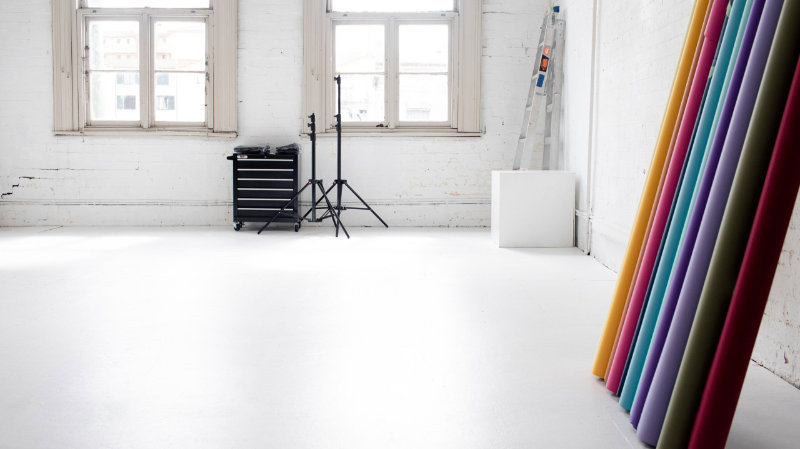
Our shooting floor is 5.7m wide and 9m deep with 4.6m ceilings, white brick walls and timber floors, and two large arch windows along one side. That combination does a few useful things at once:
- A very large, soft source. A tall window close to your subject behaves like an enormous softbox. Skin renders gently, fabric texture holds, and catchlights look natural rather than manufactured.
- Bounce you did not have to build. White brick and pale walls throw light back into the shadow side, so your contrast is already civilised before you add a reflector.
- Room to move. With 9m of depth you can pull a subject well away from the window for dramatic fall-off, or push them right up to it for flat, even beauty light. The distance is the dial.
- Height to work with. 4.6m ceilings mean full-length shots, jumps, movement and tall set pieces all fit without cropping into a ceiling.
- Blockout blinds when you want the light off. This is the part people underestimate. A daylight studio that cannot go dark is a one-trick room. Being able to kill the windows means you can switch to full studio lighting whenever the brief calls for it.
How daylight moves through a booking
The most common mistake we see is treating natural light as a constant. It is not. It changes across a session, and planning for that is the difference between a relaxed shoot and a stressful one.
- Morning light is cleaner and cooler. Early sessions tend to be soft and even, with fewer hard patches on the floor. It suits portraits, beauty, flat lays and anything where you want consistency across a lot of frames.
- Middle of the day is bright and contrasty. You get more punch and more energy, but also more risk of hot spots. This is when diffusion and distance from the window earn their keep.
- Late afternoon warms up and drops away quickly. Gorgeous for the last hour of a shoot, but do not leave your hero images until then. Shoot the must-haves while the light is stable and save the mood shots for the tail.
- Weather rewrites everything. An overcast Sydney afternoon gives you beautifully even light all day. A bright sunny one gives you shorter windows of the exact quality you planned for. Always have a fallback set-up in mind.
- Seasons shift the whole schedule. In winter the usable window is shorter and lower. In summer it stretches, but the middle of the day is harsher. Book with the season in mind, not just the clock.
A practical rule: shoot your most important looks in the first two thirds of your booking, while the light is behaving. Leave experiments for the end.
Five ways to shape daylight without buying anything
You do not need a truckload of gear to control natural light. You need to understand what moving your subject does.
- Move closer to the window for softer light. The closer the subject is to a large source, the softer and more wrapping the light becomes. Move them away and it gets contrastier and more directional.
- Turn the subject, not the light. Rotating your subject a few degrees relative to the window changes everything about how the face is modelled. Short lighting, broad lighting and a clean loop are all available in one step.
- Use the room as a reflector. Position your subject so a white wall sits on their shadow side. Free fill, no stand, no assistant.
- Subtract light to add drama. A black paper roll or a dark backdrop placed on the shadow side deepens contrast instantly. Subtraction is often more interesting than addition.
- Feather the blinds. Partially closing blockout blinds narrows the source and gives you a more directional, editorial feel. It is the cheapest light modifier in the building.
When to stop being precious and add strobe
Natural light is wonderful right up until the brief needs consistency. If you are shooting fifty e-commerce products, a full day of headshots that must match, or anything on a hard deadline, daylight will drift on you and your grade will suffer.
That is when a hybrid approach wins. Kill the windows with the blinds, set your key light and shoot to a fixed exposure. Every one of our bookings includes the lighting and backdrops, so switching modes costs you nothing but the time it takes to set up. We keep Godox heads (2 x 1200IIM and 4 x 600IIM), softboxes, strip boxes, a 140cm octa, beauty dishes, umbrellas, barn doors and gels, a snoot, a china ball, continuous LEDs, and C-stands with a boom and sandbags in the room.
You can also blend the two. Use the window as your key and a strobe or LED as a subtle rim or fill. It keeps the honesty of daylight while giving you a floor of consistency you can rely on. If you want to go deeper on the technique side, our guide to mastering natural and studio light breaks it down properly, and choosing studio lighting to rent covers modifiers in more detail.
Booking a daylight studio: what to ask before you pay
If you are comparing photography rooms and studio spaces around Sydney, these are the questions worth asking every one of them:
- Which way do the windows face, and how many are there? One large window on a long wall is far more useful than four small ones scattered around.
- Can the daylight be blocked out completely? If the answer is no, you have a daylight-only room, not a studio.
- How deep is the shooting floor? Depth is what lets you control fall-off and shoot full-length.
- Are lighting and backdrops included, or extra? Ours are included. Many are not, and the difference adds up quickly.
- Is there somewhere for talent to change and get ready? A change area and green room keeps a shoot moving instead of stalling between looks.
- What happens if the weather turns? A room that can go from daylight to fully lit means bad weather is an inconvenience, not a cancellation.
For a fuller walkthrough of the booking side, have a read of what to expect inside a Sydney photography studio and our complete guide to hiring a photography studio in Sydney.
Frequently Asked Questions
Is Desk and Studio a natural light studio?
Yes, and it is also a fully equipped studio. The shooting floor has two large arch windows, white brick and timber floors, and blockout blinds so you can shut the daylight out entirely and shoot with strobe or continuous light instead.
What time of day is best for a natural light shoot?
Morning tends to be the most consistent, and late afternoon the most atmospheric. If your images need to match across a long session, book earlier and shoot your key looks first.
Do I need to bring my own lighting?
No. Lighting and backdrops are included in every studio booking, so you can work with daylight, with strobe, or with a mix of both without hiring anything extra. If you would rather take gear off site, have a look at our dry hire options.
How much does it cost to hire the studio?
Half day hire is $380 and a full day is $620, with a weeknight two hour session at $280 and additional hours at $110 per hour. All prices include GST, lighting and backdrops. Student concession rates are available.
What if it is raining on my shoot day?
Overcast weather often gives you the softest, most even natural light of all. If the conditions are not what you planned for, you can switch to studio lighting in the same room without rescheduling.
Come and see the light for yourself
The honest truth about a daylight studio is that you cannot judge it from photographs on a website. You have to stand in the room, watch the light land, and picture your own work in it. We would love to show you.
If you are planning a portrait, beauty, fashion, product or content shoot and you want a space that gives you both beautiful daylight and full studio control, book now or get in touch and we will help you pick the right hours for your brief. Ready to take a tour?
More Articles
- Hiring a Studio for an E-commerce or Apparel Shoot in Sydney
- Hiring a Studio for a Group or Team Photo in Sydney
- Photo Studio Hire by Area: Comparing Sydney Inner West, CBD and Alexandria
- Content Studio Hire in Sydney: Shoot a Month of Social Content in One Session
- Your Studio Shoot Day Run Sheet: How to Plan a Half Day or Full Day Hire in Sydney
- Natural Light Studio Hire in Sydney: How to Make the Most of a Daylight Studio
- How Much Does a Hot Desk Cost in Sydney? Day, Week and Month Rates
- Hiring a Studio for Dance, Movement and Performer Portraits in Sydney
- Photography Space for Rent in Sydney: What You Actually Get
- Hiring a Studio for a Beauty, Hair or Makeup Portfolio Shoot in Sydney
- Hiring a Studio for Family and Kids Photography in Sydney
- Hiring a Studio for a Fashion or Editorial Shoot in Sydney
- What to Expect Inside a Sydney Photography Studio
- Hiring a Studio for Headshots: How to Run a Smooth Headshot Day in Sydney
- How to Hire a Photography Studio for a Day in Sydney
- Affordable Photography Studio Hire in Sydney: How to Shoot on a Budget
- Renting Your Own Photography Studio vs Hiring by the Hour in Sydney
- How to Hire a Studio to Run Your Own Photography Workshop or Class in Sydney
- Product Photography in a Hired Studio: How to Plan, Light and Shoot Like a Pro
- Choosing Studio Lighting to Rent: A Photographer's Guide to Lights, Modifiers and Backdrops
- Your First Studio Photography Shoot: A Beginner's Guide
- Photography Studio Rental in Sydney
- Photography Workshops in Sydney and How to Choose One
- How to Find a Photo Studio Near You in Sydney
- Photo Studio Hire in Sydney's Inner West
- How to Choose the Right Photoshoot Space in Sydney
- Self-Shoot Studios: How to Take Your Own Photos in a Hired Space
- How to Hire a Studio for a Boudoir or Portrait Shoot
- How to Hire a Photography Studio in Sydney: The Complete Guide
- How Much Does It Cost to Hire a Photography Studio in Sydney?
- Hot Desk & Creative Coworking in Sydney's Inner West
- Hiring a Video Studio in Sydney: Green Screen, Lighting and Sound
- Dry Hire Explained: Renting Studio Lighting & Backdrops in Sydney
- Planning a Content or Personal Branding Shoot in a Sydney Studio
- Click, Learn, Repeat: A Photographer’s Growth Guide
- The Power of Versatility: Mastering Natural and Studio Light in Photography